
The Pros and Cons of Merger Control
Our annual international Pros and Cons conference, where academics and practitioners meet and discuss critical aspects of competition law and policy took place in Stockholm on Monday 5 October 2026. Previous conferences, widely attended by enforcers, lawyers and consultants, have been greatly appreciated and this year’s event was no exception.
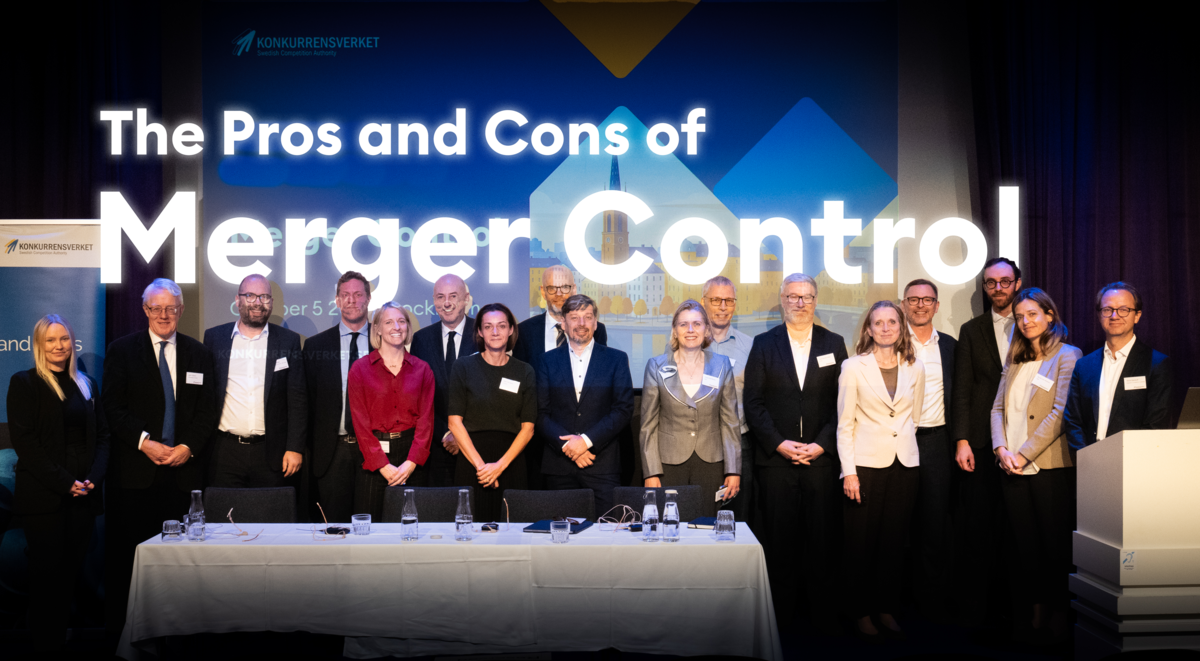
Contributors: Nicole Calo-Niiranen, Saar Dierckens, Tomaso Duso, Kirsten Edwards-Warren, Griet Jans, Olli Kauppi, Karl Lundvall, Frank Montag, Jorge Padilla, Magnus F. Reitan, Lars-Hendrik Röller, Thibault Schrepel, Fiona Scott Morton, Otto Toivanen, Ingrid Vandenborre, John Vickers, Hans Zenger, Marie Östman.
The theme of the 24th edition of the Pros and Cons conference in 2026 was Merger Control and its links to Competition Policy.
The debate highlighted an important strand of the debate on how Europe best can meet the challenges posed by global competition, sluggish productivity growth and insufficient innovation evolves around competition policy and, more specifically, merger control.
Advocates for a more lenient and less strict regime points to the need of a more dynamic approach, where consolidations in sectors with potential to deliver productivity growth and innovation should be encouraged, not restrained.
Opponents of this view usually highlights the role of competition itself as a driver for the very same objectives, and that scale possesses no intrinsic pro-competitive qualities. Rather, whereas scale can improve productivity, it can also enhance competitiveness, but fewer players in the market mean less rivalry and less incentives to outcompete rivals by offering better products and less pressure to produce these at lower costs.
The Pros and Cons 2026 conference invited alternative perspectives on this debate from prominent scholars, regulators and private practitioners.
Topics and summary of the conference:
Recording from the welcome address by Marie Östman, Director General, Swedish Competition Authority and Keynote address by John Vickers, Professor, University of Oxford:
Panel 1: Do mergers drive innovation and productivity growth, or do they stifle competition? Which effect ultimately dominates?
Fiona Scott Morton, Professor, Yale University
Frank Montag, Partner, Freshfields
Tomaso Duso, Professor, DIW Berlin, TU Berlin
Otto Toivanen, Professor, Aalto University
Moderator: Olli Kauppi, Chief Economist, Finnish Competition and Consumer Authority
The panel discussed whether mergers promote innovation or weaken the rivalry needed to sustain it. How should authorities weigh dynamic benefits against potential harm, and what can empirical evidence tell them about individual transactions?
Otto Toivanen, Professor at Aalto University, argued that competition policy belongs within a broader innovation policy, alongside research support, intellectual property rights and education. He saw no inherent conflict between protecting rivalry and fostering innovation, but warned that political ambitions to create European champions could generate tensions. He later stressed that average effects cannot determine an individual merger’s outcome and that direct evidence on the effects of dynamic mergers on consumer welfare remains limited.
Fiona Scott Morton, Professor of Economics at Yale University, emphasised incentives to compete for future customers rather than attempts to predict specific inventions. Drawing on competing approaches to cancer detection, she highlighted the value of independent research efforts. Consolidation could lead management to favour one scientific approach before it was clear which would succeed, reducing the diversity of innovation.
Tomaso Duso, Professor, DIW Berlin, TU Berlin, pointed to empirical evidence suggesting that mergers were, on average, harmful to innovation. He cited a study reporting an average 18% decline in patenting among merging firms and their rivals, alongside higher markups and profitability. However, he acknowledged that outcomes differed and stressed the importance of examining the acquirer’s experience and the projects being acquired when identifying potential benefits.
Frank Montag, Partner at Freshfields in Brussels, called for equal analytical rigour when evaluating dynamic harms and substantiated benefits, while recognising differences in evidentiary burdens. Authorities should compare the merger with realistic alternatives, including another buyer or the target’s exit, rather than assuming that firms would remain independently financed and innovative without the transaction.
Responding to Montag, Scott Morton argued that empirical findings should inform enforcement presumptions. Investigating every possible future scenario would be costly and could favour well-resourced merging parties over authorities. She questioned the value of further research if its findings could not shape enforcement practice. Montag maintained that intervention required proof that harm was more likely than not in the individual case.
Turning to efficiencies, Duso argued that past evidence pointed towards under-enforcement rather than over-enforcement. He supported strict requirements that efficiencies be verifiable, merger-specific and passed on to consumers, while calling for clearer guidance on acceptable evidence. Montag explained that cost, timing and concerns that efficiency claims might be interpreted as acknowledging a competition problem discouraged firms from presenting them early, creating practical obstacles to their assessment.
Recording from panel 1
Panel 2: More strict, more lax or just more accurate? Which is the key challenge for merger control?
Hans Zenger, Head of Unit at the Chief Economist Team of DG Competition
Lars-Hendrik Röller, Founder & Chairman, Berlin Global Dialogue, Professor of Economics, ESMT
Nicole Calo-Niiranen, Head of antitrust, ABB
Jorge Padilla, Chair, Compass Lexecon International
Moderator: Thibault Schrepel, Associate Professor, Vrije Universiteit Amsterdam
The panel discussed the practical challenges of assessing dynamic mergers under the European Commission’s draft guidelines. Should European competitiveness influence merger decisions, and how can future benefits be recognised without undermining legal certainty and rigorous competition analysis?
Nicole Calo-Niiranen, Global Head of Antitrust at ABB, argued that merger control should protect effective competition rather than create European champions. Predictability and fairness were essential, while other policy instruments were better suited to industrial objectives. She also questioned whether companies could meet the draft’s requirements for dynamic efficiencies, particularly the need to demonstrate that benefits would not arise without the merger.
Jorge Padilla, Chair, Compass Lexecon International, argued that merger policy was not the main cause of Europe’s productivity problems, but that its effects on investment and innovation could not be ignored. Acquisitions provided an exit route that could encourage investment, making it important not to dismiss credible efficiency claims. He called for benefits and harms to be assessed against the same counterfactual and criticised the lack of a clear indication of how much harm the claimed efficiencies needed to offset.
Lars-Hendrik Röller, Professor of Economics at ESMT, warned that introducing broader political objectives into competition analysis could create opportunities for lobbying and political influence. He was particularly concerned about resilience, security and dependency, arguing that these were distinct concepts for which the draft lacked a sufficiently clear analytical framework.
Hans Zenger, from the European Commission’s Chief Economist Team, stressed that competition must remain the governing standard. The theory of benefits should explain how complementarities strengthened rivalry, rather than justify greater market power through size. On dynamic efficiencies, he favoured examining changes in firms’ incentives to compete, rather than predicting specific products and prices many years ahead. Practical assessment methods would need to develop through case experience.
Turning to remedies, Padilla supported investment commitments where they delivered consumer benefits sufficient to offset harm, included detailed milestones and independent monitoring, and carried consequences for non-compliance. Calo-Niiranen favoured flexibility, but considered such commitments an option for particular cases rather than a general requirement. Zenger cautioned that one-off investments could not necessarily restore lasting incentives to compete. He distinguished these from behavioural remedies that enabled a rival to establish a sustainable competitive presence.
Finally, Padilla called for clearer criteria for when benefits outweighed harm. Calo-Niiranen wanted stronger market-share safe harbours, while Röller sought greater precision in the treatment of resilience. Zenger called for clearer limiting principles in the section on ecosystems and emphasised the importance of incorporating consultation feedback into the final guidelines.
Recording from panel 2
Panel 3: What makes remedies effective? What can parties and agencies learn from experience?
Ingrid Vandenborre, Head of European Antitrust/Competition Practice, Skadden
Griet Jans, Chief Economist, Belgian Competition Authority
Kirsten Edwards-Warren, Founding Partner, Econic Partners
Saar Dierckens, Global Head of Legal Competition, Siemens AG
Moderator: Magnus F. Reitan, Deputy Director, Department for Food, Retail and Health, Norwegian Competition Authority
The panel discussed how merger remedies could preserve competition without preventing otherwise beneficial transactions. How can authorities avoid both unnecessary prohibitions and approvals based on ineffective remedies, particularly as markets and business models become more complex?
Kirsten Edwards-Warren, Founding Partner at Econic, distinguished remedies’ effects on individual markets from their wider influence on companies’ merger decisions. Previous decisions helped firms anticipate which remedies authorities would accept and what they would cost. She noted that agency evaluations were generally more positive than academic studies. Successful implementation and the continued survival of a divested business did not, by themselves, demonstrate that a remedy had protected consumer welfare.
Sara Dierckens, Head of Competition Law at Siemens, explained that companies assessed potential remedies early because they affected valuations, negotiations and contractual risk allocation. However, designing a viable package was increasingly difficult in industrial software, where different applications depended on shared platforms. Addressing a concern in one segment could affect other parts of the business, requiring complex combinations of divestitures, licensing and platform duplication rather than a straightforward sale.
Griet Jans, Chief Economist at The Belgian Competition Authority, emphasised that effectiveness remained the central requirement. Authorities should help otherwise beneficial transactions proceed, but remedy discussions should not become a route for approving fundamentally harmful deals. She called for early engagement and sufficient time for revisions and market testing. Behavioural remedies could work with appropriate expertise and indeingridpendent monitoring, although she was more sceptical about investment commitments.
Ingrid Vandenborre, Head of Competition Law at Skadden in Brussels, argued that remedies needed to match the specific theory of harm. A strong preference for divestitures might not fit increasingly dynamic and forward-looking concerns. She called for greater flexibility and a revision of the remedies notice alongside the merger guidelines, linking theories of harm and benefit to a corresponding approach to remedies that also preserved the transaction’s benefits.
Returning to the assessment process, Edwards-Warren questioned why economists devoted substantial attention to scenarios with and without a merger, but much less to the scenario ultimately implemented: the merger with remedies. She called for greater economic input into remedy design, including analysis of wider effects on incentives, bargaining positions and pricing rather than only the immediate competition concern.
Finally, the discussion turned to collecting data for retrospective evaluation. Dierckens highlighted companies’ concerns that information could be misunderstood or used against them. Vandenborre warned that narrow assessments of a divested business could overlook changes across the wider market. Edwards-Warren argued that data collection could nevertheless be designed to protect confidentiality and support research without reopening the original case or requiring companies to defend it again.
Recording from panel 3
The information on the website will continuously be updated.